
Write us
info@agrigyan.com
+91 9999052385
Request a call back

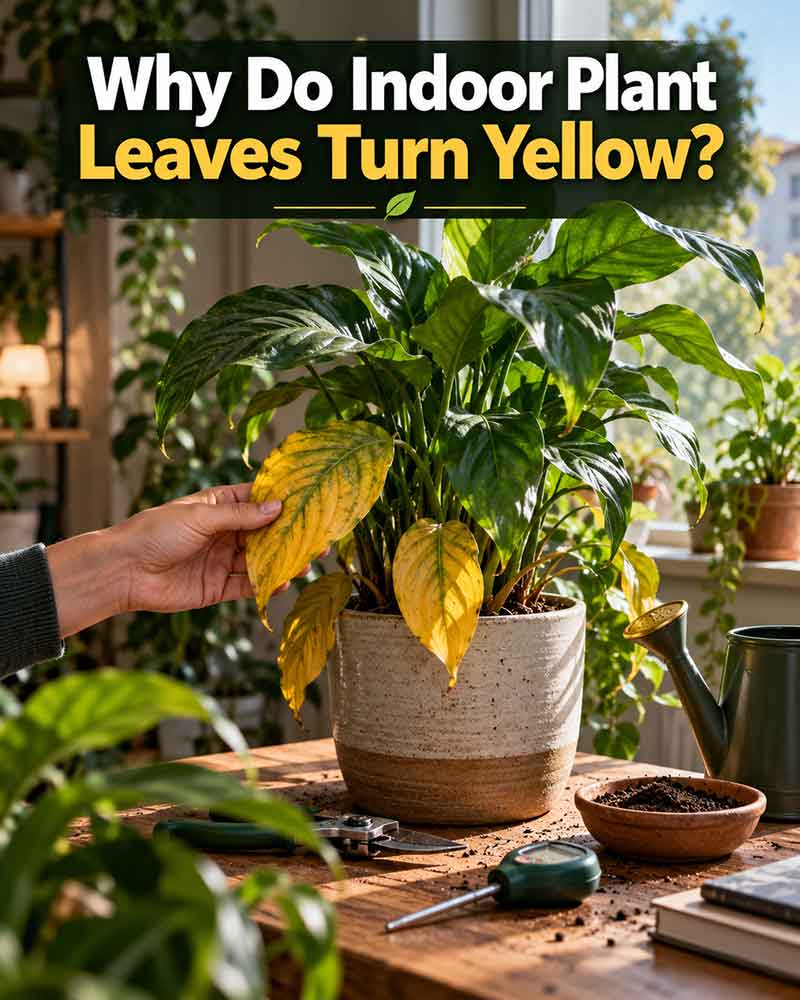
Why Do Indoor Plant Leaves Turn Yellow?
Indoor plants face a slightly different set of challenges than outdoor or balcony plants — more limited and consistent light, less airflow, and often a smaller soil volume that dries out or stays wet in less predictable ways. While many of the general causes of yellowing leaves apply indoors too, a few factors are particularly common in indoor settings specifically. This guide focuses on why indoor plant leaves turn yellow and how to address each cause.
1. Insufficient Light Indoors
This is one of the most common causes specific to indoor growing. Even a room that looks reasonably bright to the human eye often provides far less usable light than a plant actually needs, since indoor light levels drop off sharply with distance from a window. A plant slowly yellowing and losing lower leaves, especially one placed several feet back from any window, is very often simply not getting enough light to sustain all of its existing foliage.
Move the plant closer to a window, or rotate it regularly if only one side gets decent light, and consider a small grow light for particularly dim interior spaces.
2. Overwatering (More Common Indoors)
Indoor plants generally use water more slowly than outdoor plants because indoor conditions usually mean lower light and less airflow, both of which slow down how quickly soil dries out. A watering routine that worked fine for a balcony plant in bright sun can easily overwater the same plant kept indoors. Always check soil moisture with a finger test before watering an indoor plant rather than watering on a fixed schedule.
3. Low Humidity From AC or Heating
Air conditioning and heating both reduce indoor humidity significantly, and many popular houseplants originate from humid tropical environments, making them sensitive to this dry indoor air. Low humidity can cause yellowing, browning leaf edges, and general stress, particularly in rooms that run AC for long hours daily. Grouping plants together, using a small humidity tray with water and pebbles beneath pots, or occasional misting can help offset this indoor-specific stress.
4. Nutrient Depletion in a Fixed Soil Volume
Indoor plants live in a fixed, often smaller volume of soil for extended periods, sometimes years, without being replenished, which means nutrients deplete steadily and need regular topping up. Uniform yellowing starting with older leaves, paired with slow growth, often points to this cause, especially if the plant hasn't been fed or repotted in over six months.
5. Natural Leaf Drop
Indoor plants, like outdoor ones, naturally shed their oldest leaves occasionally as part of normal growth. If only a leaf or two near the base is yellowing while the rest of the plant looks healthy and continues producing new growth, this is usually not a cause for concern.
How Indoor Yellowing Differs From Outdoor Yellowing
While overwatering, nutrient deficiency, and natural leaf drop affect outdoor and indoor plants alike, the underlying trigger is often different indoors. An outdoor plant is far more likely to dry out too quickly in direct sun and heat, while an indoor plant is far more likely to stay too wet for too long simply because it's using water more slowly in lower light and still air. This is why the very same watering routine that keeps an outdoor plant perfectly healthy can quietly overwater the same species once it's brought indoors, and it's one of the most common surprises new indoor plant owners run into.
Pest Checks Shouldn't Be Skipped Indoors
It's easy to assume indoor plants are safer from pests than outdoor ones, but mealybugs, spider mites, and whiteflies can all establish indoors, often arriving on a new plant brought into the home. Since indoor pest populations don't have natural predators to keep them in check the way outdoor gardens sometimes do, a light infestation can quietly cause patchy yellowing that gets mistaken for a watering or light issue. A quick check of leaf undersides and stem joints is worth doing whenever yellowing appears, even indoors.
Indoor-Specific Diagnostic Checklist
- How far is the plant from the nearest window, and how many hours of usable light does it realistically get?
- Has the watering routine been adjusted for indoor conditions, or is it still based on a brighter outdoor schedule?
- Does the room run AC or heating for long hours, and could dry air be a factor?
- When was the plant last fed or repotted?
- Is only a small number of older leaves affected, suggesting natural leaf drop rather than a problem?